


You hear it occasionally: "we have hard water here." Usually in the context of limescale on faucets or a kettle that looks twenty years old after two months. But what exactly is water hardness? And what does it mean for your skin and hair?
What water hardness is
Water hardness is the amount of calcium and magnesium dissolved in your tap water. It is measured in German degrees (°dH) or French degrees (°f). The higher the number, the harder the water.
Soft water: below 8 °dH. Medium: 8 to 12 °dH. Hard: 12 to 18 °dH. Very hard: above 18 °dH.
That distinction between "soft" and "hard" is not academic. The difference is palpable — literally.
The map of the Netherlands and Belgium
The Netherlands generally has soft to medium-hard water. The Randstad, the north, and large parts of Gelderland often have values below 10 °dH. But there are exceptions: parts of Brabant, Limburg, and Overijssel score higher. And "average soft" does not mean your municipality is soft.
Belgium is a different story. Large parts of Flanders, Brussels, and East Belgium have hard to very hard water — regularly above 25 to 30 °f. That is a substantial difference. In Brussels and Antwerp, you notice it in everything: the limescale, the stiffness of your hair after showering, the dryness of your skin.
The difference is not between countries, but between regions. Two municipalities twenty kilometers apart can have completely different values.
What hard water does
The calcium and magnesium ions in hard water leave an invisible residue on surfaces. On your faucet, you see this as white scale. On your skin and hair, you don't see it — but you feel it.
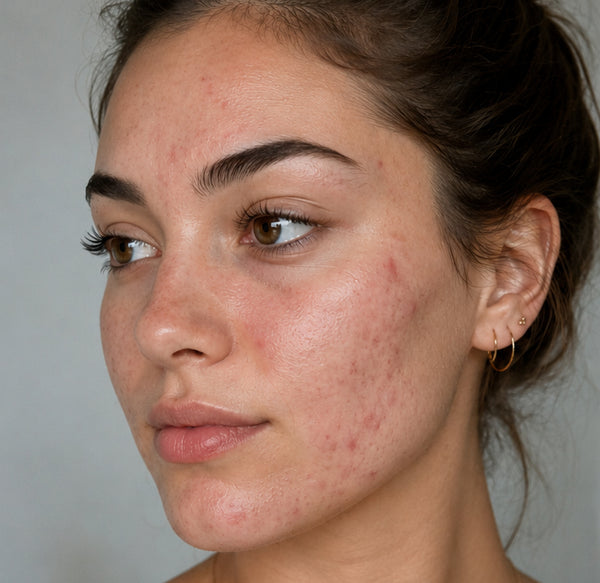
This residue forms a film that can clog pores and disrupt your skin's pH balance. The result: skin that feels drier, becomes irritated more easily, and responds less effectively to skincare products. Your hair becomes porous, dull, and brittle. Dyed hair loses color faster.
With soft water, these effects are minimal. But even soft water still contains chlorine — and that has its own impact on your skin barrier.
What soft water doesn't solve
If you live in a region with soft water, you experience less limescale residue. But you still have to deal with chlorine. Drinking water companies add chlorine as a disinfectant. This is necessary and effective — but by the time the water reaches your skin, it is a residual product that can affect your sebum layer.
Hard water therefore gives you two problems: limescale and chlorine. Soft water gives you one: chlorine. Neither is dangerous. But both are relevant if you take your skin seriously.
Check your own situation
The water hardness of your municipality is public information. You can look it up at your local drinking water company, or use our water hardness checker on the website. Enter your postcode and you will immediately see the values for your region.
No email needed, no account, no obligations. Just the data.